Understanding Propylene Glycol and Vegetable Glycerin
By Guy Hurley
Jun 26, 2026

Flip over a bottle of your favourite e-liquid, and you will likely spot two confusing acronyms: PG and VG. While these terms sound like an advanced chemistry experiment, they are actually the invisible foundation of vape juice formulations.
Rather than acting as optional extras, these clear liquids serve as the essential base ingredients that carry flavour concentrates and nicotine in e-liquid. Manufacturers rely on propylene glycol and vegetable glycerin because both function as humectants — helping control moisture and, most importantly, determining how vapour is produced and how flavour is delivered in vaping.
Anyone reading a vape label might naturally wonder if these unfamiliar components are safe to inhale. In the UK, all nicotine-containing e-liquids must comply with the Tobacco and Related Products Regulations (TRPR), enforced by the MHRA and Trading Standards. These regulations define strict manufacturing, safety, and labelling standards for all legal vape products sold in the UK.
Both PG and VG are widely used in food, pharmaceutical, and cosmetic industries and are generally recognised as safe for ingestion. However, research into their long-term effects when inhaled through vaping is still ongoing.
Understanding their role in e-liquid is just the beginning — the real difference comes from how PG and VG behave when vaporised inside your device.
PG vs VG: The Key Differences at a Glance
- Propylene Glycol (PG): Thin, fast-absorbing liquid focused on flavour delivery and throat hit
- Vegetable Glycerin (VG): Thick, slow-moving liquid focused on vapour production and smoothness
- PG performance: Best for flavour clarity, nicotine delivery, and smaller vape devices
- VG performance: Best for dense clouds, smoother inhale, and sub-ohm vaping
This simple difference in thickness is what determines almost everything about how an e-liquid performs — from taste intensity to coil life and vapour production.
Which is Better: PG or VG?
Neither PG nor VG is objectively better — the right choice depends entirely on your device and vaping preference.
- Choose PG if you want: stronger flavour, sharper throat hit, and compatibility with pod systems
- Choose VG if you want: smoother inhale, larger vapour clouds, and reduced throat irritation
Most e-liquids use a blend of both to balance performance, which is why PG/VG ratios are so important when selecting the right product.
Propylene Glycol: Why This 'Flavour Carrier' is Essential for Vape Intensity
When comparing PG vs. VG in vaping, Propylene Glycol is the key ingredient behind strong, clear flavour delivery. PG — a synthetic, thin base liquid — is chosen for three defining characteristics:
- It is completely colourless.
- It is entirely odourless.
- It has a very low viscosity ideal for vaping devices.
Because PG is so thin, it behaves more like water than syrup. This allows it to soak quickly into vape cotton wicks, ensuring consistent vapour production and strong flavour transfer without clogging coils.
Think of PG as a clean flavour carrier: it allows vape concentrates to express themselves fully without muting intensity. This is why it is widely used in e-liquids designed for flavour clarity and throat hit.
Vegetable Glycerin: The Secret to Dense Vapour and Smooth Inhalation
Vegetable Glycerin (VG) is the smoother, thicker counterpart to PG in e-liquid formulation. It is derived from plant oils such as soy, coconut, or palm.
The defining characteristic of VG is its syrup-like consistency, which directly impacts how it performs in vape devices. Instead of focusing on flavour sharpness, VG is responsible for producing dense vapour clouds and a smoother inhale.
VG also has a naturally mild sweetness, which can slightly soften or round out vape flavours — especially in dessert and creamy blends.
PG vs VG Viscosity: Why Thickness Matters
The difference between PG and VG in vaping can be understood through viscosity. PG behaves like water, while VG behaves like syrup — and this affects everything from wicking speed to coil performance.
In vape kits and pods, cotton must absorb liquid efficiently to prevent dry hits.
- Wicking Speed: PG absorbs quickly; VG absorbs slowly
- Coil Performance: PG keeps coils cleaner; VG may require more powerful hardware
- Vapour Production: VG produces dense clouds; PG produces lighter vapour
These differences are critical when choosing e-liquid, as the wrong ratio can lead to burnt coils or poor performance.
Finding Your Perfect PG/VG Ratio
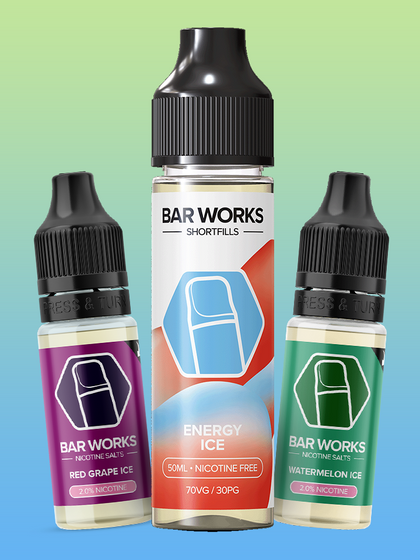
On any bottle of e-liquid, you will see ratios such as 50/50 or 70/30. These indicate the balance between PG and VG.
- 50/50: Ideal for pod systems and mouth-to-lung vaping with strong flavour and nicotine delivery
- 70/30: Best for sub-ohm vaping with large vapour clouds and smoother inhale
- 80/20: Designed for cloud chasing and minimal throat irritation
Choosing the right ratio depends entirely on your device and vaping style.
Is PG vs VG Safe for Vaping?
PG and VG are widely used in food, pharmaceutical, and cosmetic products and are generally recognised as safe for ingestion.
However, vaping involves inhalation rather than ingestion, and long-term research is still ongoing into the effects of inhaled aerosols.
Some users may experience sensitivity to PG, including throat irritation or dryness. In these cases, higher VG blends or 100% VG e-liquids are often preferred.
Choosing regulated, properly manufactured products under UK TRPR standards is essential for safer vaping.
The Label Reader’s Guide: Choosing the Right E-Liquid
Understanding PG and VG allows you to confidently choose the right e-liquid for your setup.
The key is matching your device type, nicotine strength, and preferred PG/VG ratio.
Proper storage is also important — keep e-liquids sealed, away from heat and sunlight to preserve quality and flavour stability.
Once you understand PG and VG, choosing the right vape juice becomes simple and predictable rather than guesswork.
Leave a comment